Showing posts with label Rhodes. Show all posts

Tuesday, 26 May 2015

The Hospital, Rhodes

The Conventual Hospital was one of the most  important and impressive buildings on Rhodes. It was one of the major hospitals of the Mediterranean and remains the best preserved of the Order's hospitals. As recorded by the memorial inscription above the front entrance, work began on the 15th July 1440 and also that Grand Master Fra' Antonio Fluvian (1428-1437) (whose arms are held above by two angels carved in relief), donated 10 000 florins to the costs.

The imposing facade reflects the importance that the Order always regarded their duty towards the sick and the poor. The original doors of richly carved cypress  were removed in 1836 as a gift from the Ottoman sultan to King Louis Philippe 1 of France who had them hung in the Hall of the Crusades at Versailles. 


The entrance leads through a ribbed and cross vaulted passage into a large square courtyard surrounded by a two storeyed gallery with ribbed cross vaults on the ground floor and flat wooden ceilings on the upper level. This arrangement is said to have derived from Byzantine xenodochia (hospices), or caravanserei in which central courtyards are surrounded by arcaded two storey cloister as at Rhodes. Around the courtyard at ground level are vaulted storerooms. Access to those on the east and north sides are from the street outside and were rented out as shops to provide an income for the resident clergy. Access to the storerooms on the other two sides is from within the courtyard.


A wide stone staircase to the left of the entrance leads from the courtyard to the upper storey where the medical departments were located. On the north and west sides of the upper storey are small simple rooms, each with a fireplace, where ill brethren or other noble patients could be treated. (Unlike in the Holy Land, at Rhodes the Order did not maintain a separate establishment for sick brethren.)The entrance to the large hospital ward is on the upper gallery immediately above the entrance passage.


The Great Ward is 51m long and 12.5 m wide and divided down the length of the hall into two by a colonnade of octagonal stone pillars. The plain capitals are embellished with the heraldic device of the order of St John and of grand master d'Aubusson in alternation. Some of the original roof timbers survive on which are found the arms of the Hospital's founder Fluvian and also those of de Lastic and d'Aubusson. Along the two long sides of the ward are small vaulted cubicles built into the thickness of the walls; the result of concealed buttresses which served as privvies. Great wards such as this are based on the European hospitals, the hotels-Dieu. A large fireplace would have taken some of the chill away in the winter or more likely a provide a place for patients to huddle and feel some warmth in winter.

The great ward could probably accommodate 100 patients; each of whom had his own bed surrounded by a curtain and had his food served from a silver platter and slept at night between clean sheets. On admission a patient had to say confession and take Holy Communion and make their will in the presence of a chaplain and a scribe.


The Hospital was described by Czech pilgrim John Lord of Lobkowitz in 1493 when he and his servant were put up there and fed on white bread and wine:

        "That house, the Infirmary, is all built of cut stone and the inside is a straight square. and windows great and broad all around, that there is little wall between these windows: but one window next to the other, so that one may look into the house, and all of it is finely painted. Now the Master of Rhodes had endowed that house, that any man being Christian, of whatever lowly or great rank, who shall come there, if he be sick and ask it for God's sake, should at once be taken in; and there he is at once provided with medicine and other necessities, to wit food and drink and bedclothes. If an impatient person, he is given a room of his own; and if any lesser man, then there is a fine hall, and in it made beds in double row, and on some on them sick people are lying. And these beds are well made with clean white bedclothes, and on each bed there is a red cloth blanket, for there it is not as cold as (in Bohemia). And near each of these beds a door opens upon the balcony; and there too he has a privvy."

       "Also it is ordained that, each of the sick has a servant, that looks after him and serves him, whatever he needs. Also two doctors are ordained for this, sworn leeches, who look after the sick twice each day: once in the morning and once again in the evening. And there are these doctors having in the morning examined his water......

         "Further the same doctors write a paper, what sort of dish should be given him, and when; and there these officials appointed for this must so provide this, what time these doctors write and order it. And those things are entrusted to three men: one Knight of the Order and two clerks, all of them being on oath for this. Also at that time i saw the sick were served their meals in silver dishes, and they drink too from silver spoons. And none need pay anything for his stay there, except freely of his goodwill gives anything to the servant that has waited upon him."

The administration of the hospital was established on Rhodes in the form it would take until the loss of Malta. In 1440 the year that the construction of the hospital began, the Order issued a detailed set of statutes which were probably the first major revision of the Hospital's regulations since those of 1182. This and subsequent legislation controlled the inspection of stores, appointment of chaplains, confession and prayer, diet and clothing, precautions against fraud, alms and bequests. 

The Hospitaller of the Langue of France (magnus hospitalarius) was in overall charge, although he remained accountable to the Grand Master and the Council, and ultimately to the General Chapter for important decisions and for the confirmation in office of his subordinates. The Infirmarian, (infermarius) also from the Langue of France was in charge of the day to day running of the hospital. He received the patients, visited them in their beds and ensured that they received the treatment prescribed by the doctors. A scribe recorded the notes and also recorded the testimonial wishes of the sick.

The Order employed professional doctors who were expected to visit the wards twice a day and one of them had to be on duty at night. The doctors always attended the sick under the supervision of the infirmarian and eight brothers, one from each langue at the Convent. They were accompanied by a scribe who together with the infirmarian, noted down the doctors prescriptions and saw that they were properly observed. the hospital also employed two surgeons.

In 1445 the Master, somewhat exceptionally employed a Jewish doctor, Jacunda Gratiano, fiscius et professor actis medicine, to practice in the Conventual hospital after having taken an oath on the Jewish scriptures.

For their part the patients were not allowed to question the doctors decisions nor change their prescribed diet. Patients were also obliged to be silent, to desist from playing cards or dice and refrain from reading books not associated with the christian religion.

Besides those who were sick or ill the hospital also treated causalities of war. in 1445, following the Egyptian attack on Rhodes, certificates of mutilation were issued so that those who for example had had a hand amputated in the hospital would not be regarded as criminals.


Half way along the ward, opposite the door and above the main entrance below is the polygonal apse of the chapel. A chaplain, later the prior of the hospital, administered the sacraments and coordinated the religious life of the institution. Every morning the chaplains processed through the great ward and celebrated Mass before the altar in the small three sided Gothic chapel.

The chaplains were charged with administering holy Communion and the Last Rites to the sick and singing the Requiem Mass in the event of a death. Every evening at sunset the chaplains gathered in the great ward to recite the great prayer for 'Our lords the Sick.'

                               'Seigneurs Malades,
                                pries pour pais que Dieu la monde de ceil du terre.
                               Seigneurs Malades,
                               pries pour le fruit de la terre que Dieu le multiplie entelle
                               maniere que sancte eglise en sort serv ie et le people
                               soutenou.
                               Seigneurs Malades,
                               pries pour l'apostell de Rome et pour les cordennaus et pour les
                               patriaches et pour les arcevesques et pour les evesques et les
                               prelate...........'

They prayed too for all Christian kings, pilgrims, captives and benefactors. (The ancient custom  of parading the responsions in front of the sick had been discontinued by 1340.)
                                                  

A small door in the southern corner of the Great Ward leads into a second smaller chamber with a polygonal column in the middle, supporting two arches that in turn supports the wooden roof. It is thought that this room served as a refectory. 


There was a fully stocked pharmacy with an elaborate system for the storage and checking of the quality of the drugs and medicines. All poisons were kept under lock and key.


Pharmacy jars from Rhodes 
( St John's Gate, Clerkenwell)

Pharmacy jars bearing the arms of Grand Master Fra' Phillipe Villiers de l'Isle-Adam
(1521-1523)
(St John's Gate, Clerkenwell)

In addition to his responsibility for the Conventual Hospital the grand hospitaller was also head of those services that the Order provided for the poor, for widows and orphans and those struck by misfortune in general. Since the 12th century the office of the elemosinaruis looked after the homeless. The General Chapter of 1182 outlined measures that could be taken for the relief of the poor. Penniless newly weds for instance were given a gift on their wedding day and prisoners released from jail money to start a new life. The Hospital was to provide subsistence for thirty paupers including five clerics and that anyone who needed it was entitled to food, bread and wine three times a week. Every Saturday during Lent, thirteen paupers, including three clerics  were fed clothed and given a small sum of money. The elemosinarius also oversaw a team of workers who repair old shoes and clothes for the poor. The General Chapter of 1182 also decreed that orphans were to be brought up in the hospital.

The Order also provided a service responsible for measures promoting public health and the prevention of epidemics which were frequent and virulent in the Middle Ages. Domini sanitatis were set up in 1503. Two health commissioners, one Latin and one Greek wee elected annually to impose strict measures against the plague which included control of landings from shipping and on occasion forty days of isolation, segregation measures for lepers and measures to keep rubbish out of the sea.

 A second smaller entrance to the Hospital  leads from the Street of the Knights via a marble staircase to the upper storey. The original wooden doors were carved and bore the coat-of-arms of Grand Master Fra' Pierre d'Aubusson.  An inscription carved in the stone above the entrance states that Fra' Pierre Clouet, an official of the Order completed the hospital in 1489.


In spite of the great expense of maintaining such a magnificent establishment, the Conventual Hospital was of the greatest importance to the Order of St John not only as a religious obligation and source of ideological strength but also as a symbolic showpiece to impress visitors from the West who would take back with them the resulting image and in doing so helping to justify the Order's extensive possessions and privileges across Europe.

Monday, 26 January 2015

Stavrou Lambrou Tower, Piskopi (Tilos)

The Order of St John granted the islands of Piskopi (Tilos) and Kalkia to Borello Assanti of Ischia at two hundred florins a year. It does not appear that he became a vassal of the Order but the terms of the contract made clear that he had to provide the guard service. The Order reserved the superior lordship of the island while the falcons of the island were reserved for the master as were the rights over shipwrecks. Assanti was also constrained from exacting any service from the islanders that had not been exacted by the Order in the past.

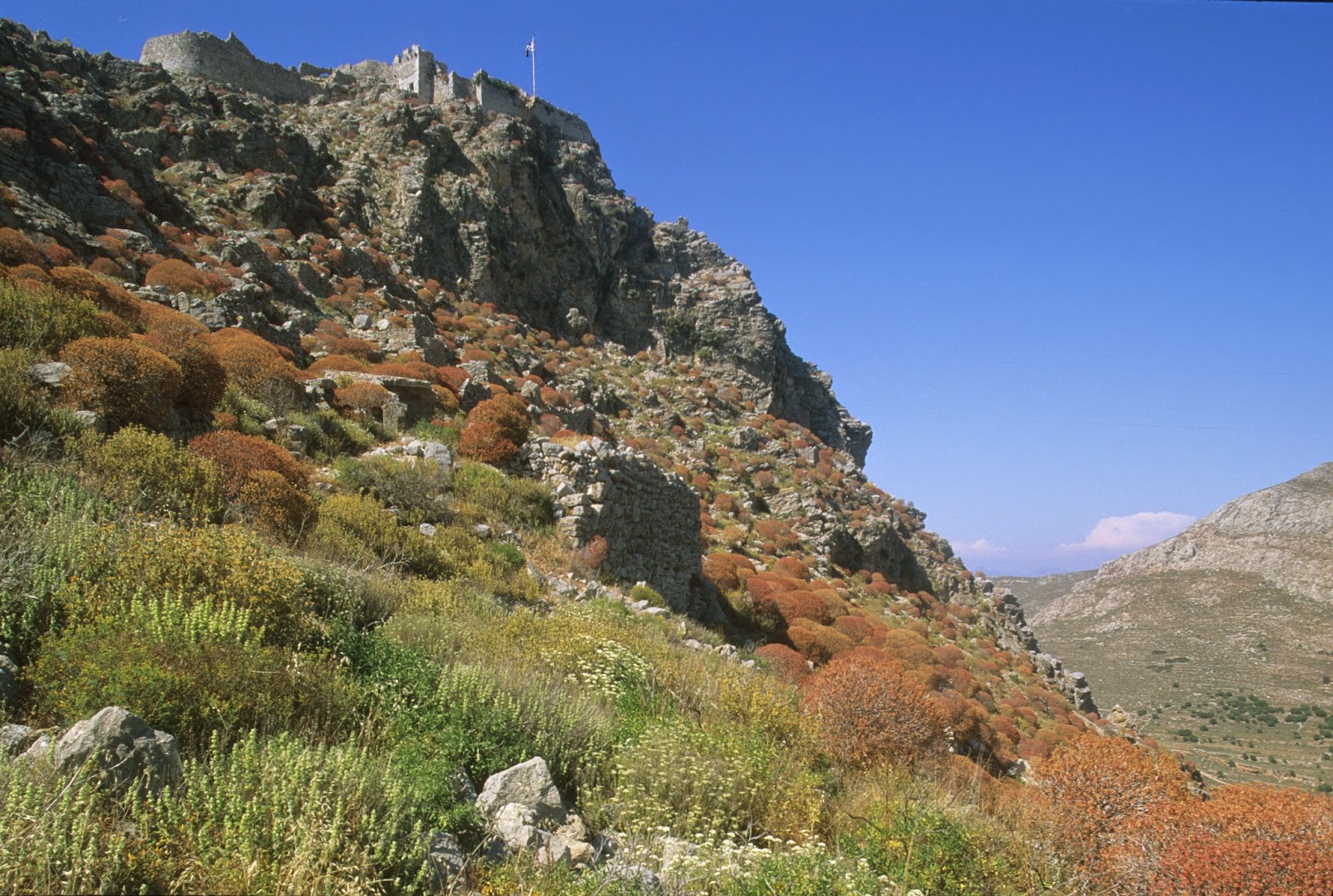
The tower at Stavrou Lambrou is built on an eerie high above the tallest sea cliffs on Piskopi. It is the strongest naturally fortified site on the island.

Stavrou Lambrou Tower

Despite being protected by the castle and towers, its small size and isolated position meant that Piskopi was vulnerable whenever the power of the Turks was in the ascendancy. In 1457 the Turks raided Piskopi together with the islands of Nisyro, Lerro and Kalymno and the village of Archangelo on Rhodes. In 1505 Kamel Reis the Ottoman admiral sacked Piskopi, Lango, Symie and Lerro. Piskopi remained part of the Hospitaller state until the siege of 1522 finally ended  their rule over the Dodecanese.

Sunday, 25 January 2015

Agrosikia Tower, Piskopi (Tilos)

Agrosikia Tower on the small island of Piskopi (Tilos) stands in the hills above the bay of Livadhia in the southeast of the island on the edge of a steep precipice.  The small tower consists of an encircling wall without a gate, entry must have been by ladder which would have been pulled up once the guard was safely inside.


In 1344 an allied fleet of Hospitaller, Papal, Cypriot, French and Venetian galleys used the indented coastline of Piskopi to ambush Yakshi, emir of Marmora in the strait between Piskopi and the Negropont mainland. In an engagement that lasted nine days, the allies outsailed and outfought the Turks who lost over 100 vessels.


Saturday, 24 January 2015

Megalo Choria Castle, Piskopi (Tilos)

Piskopi 'lookout' took its name from its mountains on which the Knights of St John built seven castles and watchtowers, most of them with commanding views over the surrounding seas. Piscopi or Tilos  is 14.5 kilometers long from northeast to southwest and about 8 kilometers at its widest point. It is about halfway between Rhodes and Lango (Cos) and 15 kilometers southeast of Nisyro (Nisyros).


The most important fortified stronghold was the castle on the summit above the present day village of Megalo Chorio. In the Knight's period the villagers lived within the castle walls as protection from pirates. The hillside had been the site of an ancient settlement and parts of the fabric of the castle, in particular the lower courses, the gatehouse and the corner towers were largely constructed from reused Classical masonry.


From the castle are clear views across the sea to Nisyro. The garrison kept watch over the channel and lit a beacon as a signal to Rhodes and the other islands if any shipping was seen passing through the strait.


The need for strong defensive positions to protect the population was emphasized c 1317 when Orcan, son and successor to Osman considered Rhodes to be defenseless in the absence of the rival masters and the division of the Order and descended on Rhodes, in the process capturing Piskopi. He used the island as a depot  for the settlers he brought in his train and sailed on to Rhodes. However Orcan's fleet was defeated by the Vicar-General Gerard de Pins and the Turkish colonists on Piskopi were either put to the sword by the victorious knights of sent into slavery.

Saturday, 17 January 2015

Street of the Knights, Rhodes

When the Convent (headquarters) of the Order of St John was transferred from Cyprus to Rhodes in 1310, the knights reserved the collachium for their own use. Those Greeks who had been living there were moved out as part of the terms of their surrender. The collachium was a separate enclave within the city, divided from the larger town by a high wall running from near the Sea Gate to near the d'Amboise Gate. The wall was protected by strong towers and from 1475, by a moat in front of the wall. The collachium was well guarded;  during Carnival nobody wearing a mask was allowed in. The Knights were only permitted to go into the town when riding a horse, or in pairs if on foot.

To begin with the Convent made use of existing buildings. But as the fledgling state became established it embarked on its own ambitious building programme. Most of the surviving medieval buildings in Rhodes date from the late 15th century, an austere style that manages to combine the ethos of a religious Order of the Church and at the same time reflect the prestige that attached itself to the capital of the Hospitaller State.

Brown sandstone facades  are embellished  by white marble plaques in which coats-of-arms are carved in relief. Some buildings  have decorative carving around the windows and doorways.  One of the most characteristic elements of the Knights' buildings on Rhodes are the  strongly marked string courses. A few of the doorways are  Renaissance in style but the majority are Gothic. However in the architecture of the Convent's buildings it is the east that predominates over the north; most of the buildings are low, without gables and have flat roofs.

The first major building project on Rhodes was the construction of the Conventual Church of St John, in a prominent position in the town, opposite the Palace of the Grand Masters. Like most of the Knights' churches, in the Gothic style but  incorporating Classical masonry in its fabric.The granite columns that divided the nave from the aisles in St John's were taken from the site of an ancient temple while the tombs of Grand Masters' de Juillac(1376) and de Milly (1441) were reused ancient Greek sarcophagi. St John's was accidentally blown up in 1856 and all that remains, apart from the foundations, is the reconstructed Loggia that connected the Conventual Church with the Palace. The Loggia or Circus sive Lobia Conventus was where every knight had to perform gun drill at least once a week. It  crosses the top end of the main thoroughfare running through the Collachium known today as the Street of the Knights.


The Street of the Knights is the grandest street in Rhodes. Along it were most of the auberges or national inns belonging to the different langues. The period that the Order stayed on Rhodes was formative in developing the structure that was to last for most of its subsequent history. What had begun as a largely informal practice on Cyprus became the formal division of the brothers serving at headquarters, the Convent, into their national groups. To begin with there were seven langues at the Convent, ranked according to seniority, Provence, Auvergne, France, Italy, Aragon, England and Germany.

In November 1320 the General Chapter changed the constitution when it decided to assign the great officers of the Order to a particular langue.Thus the pilerii or leaders of each langue held a particular position; the grand commander was the head of the Langue of Provence; the marshal marescalluas was head of the langue of Auvergne; the hospitaller hospitalarius was leader of the Langue of France; the admiral admiratus was hea of the Langue of Italy; the darper magnus conservator was head of the Langue of Aragon; the grand turcopolier, magnus turcopolerius was head of the Langue of England and the treasurer was the hea of the langue of Germany.

The balance of power within the Order caused internal friction during the rule of Grand Master de Lastic (147-1454). The predominant power of the French contingent gave them the majority of the important posts in the administration and this naturally caused resentment within the other national groups. At the General Chapter of 1461 convoked by Grand Master Zacosta a Spanish Knight, it was decided to split the Langue of Aragon into two, one part retaining the old name and rank while the other was named the Langue of Castille and assumed eighth place in the order of precedence.


Each of the langues had its own inn or auberge at Rhodes, most of them along the Street of the Knights. The size and development of each langue's inn or auberge depended on the size of each nation's representation at the Convent. The largest inn belonged to the Langue of Aragon which had the largest number of knights, while the inns of Provence, Auvergne and France were also sizable.

While the knights lived in their own houses elsewhere within the collachium, the inns were where they participated in communal life;  dined together, exchanged the gossip of the day and entertained visitors from Europe. The only members of the langue who lived at the auberge were the novices and junior knights who would have slept in a communal dormitory with in the auberge. While the auberges  project a  plain facade onto the street, many of them have an open gallery at the back that overlooks a private garden.

Near the top of the Street of the Knights part of the Auberge of Provence survives including the magnificent entrance and some parts of the ground floor. The Auberge of Provence was badly damaged in the earthquake of 1481 and was subsequently rebuild at the expense of the munificent Prior of Saint-Gilles, Fra' Charles Amen de la Rochechvaut.

Auberge of Provence

Set above the door is a cruciform frame enclosing the arms of the King of France, the Order, Grand Master del Caretto (151-1521) and Fra' F de Flota.


Opposite the Auberge of Provence on the southern side of the Street is the Auberge of Aragon, the largest auberge on Rhodes.A large doorway in the Aragonese stylle  leads into a barrell vaulted passage from where a stone staircase leads to the principal accomodation on the first floor. Besides five of six smaller rooms is a large hall measuring 19x8m at the front alongside the street which was the assembly chamber of the Spanish knights.

Auberge of Aragon

 From the hall is a passage over the street to the building opposite that may also have belonged to the Inn of Aragon. The escutcheon on the facade belongs to Grand Master Fluvian (1421-1437). After the division of the lange in 1461, the Langues of Aragon and Castille continued to use the same building.

Auberge of Aragon

One of the most imposing inns is the Auberge of France in the Street of the Knights. On the facade two mouldings follow the gradient of the street, the string course separates the ground floor from the upper story . The upper moulding skirts the windows which are decorated with a twisted rope design. Rain water was shed from the roof as the street through conical waterspouts in the form of crocodiles. At the top of the inn is a parapet with battlements, interrupted at intervals by 4 semi circular turrets. Inscriptions on the facade and internal arcade record the names of the founders and the different building phases. Like most buildings on Rhodes the Auberge of  France dates from after the Siege of 1480 and the earthquake the following year.

Auberge of  France

The Inn of Italy at the bottom of the Street is a small building in relation to the number of Italian knights serving at the Convent. A small entrance leads to courtyard with a well; every inn had its own donkey drawn well. On the bottom corner of the Street of the Knights is the magnificent Sacra Infermeria completed in 1483. 


Saturday, 1 November 2014

Archangalos, Rhodes

The village of Archangalos between Rhodes Town and Lindos was raided by the Ottomans in 1457 together with the islands of Episokopi (Telos), Nisyro (Nisyros) and Calymno (Calymnos). That was the year after Constaninople had fallen to the Ottomans and the threat to Rhodes had increased dramatically.  Under the instructions of Fra' Jacques de Milly (1454-1461) the Knights of Rhodes built a castle on a hill near Archangalos, incorporating parts of the pre-existing Byzantine fortress, to provide a safe refuge for the Greek villagers.

Tuesday, 21 October 2014

St Paul's Gate, Rhodes

St Paul's Gate was built by the Knights of St John in the second half of the 15th century to control movement between the two harbours of Rhodes, the Mandraki and the Commercial Harbour and the Mole of St Nicholas. A polygonal bulwark surrounds the tall central tower.


The coats-of-arms of Pope Sixtus IV and Grand Master d'Aubusson incorporated above it  and below the marble plaque with its relief of St Paul indicate that the tower could be dated to 1476-84. However the arrangement of the fortification  would seem to date it from an earlier period, perhaps from the rule of Grand Master Zacosta (1461-67). Pierre d'Aubusson may well have repaired the gate c.1477, when he reinforced the north wall of the city.

Friday, 16 May 2014

d'Amboise Gate, Rhodes

The most impressive gate in the fortifications of Rhodes was built by Grand Master Fra' Emery d'Amboise and completed in 1512. The d'Amboise Gate is in the north-east of the town, beneath the Palace of the Grand Masters and was the point of entry from Pheraclos, Lindos and the west of the island.


 The d'Amboise Gate is approached by a road that crosses a bridge of three arches that span the moat.  The gate is defended by two massive cylindrical towers, and it is afforded further protection by covering fire from  the powerful St George's Bastion to the south.


The d'Amboise Gate was not only the most monumental of Rhodes's gates, it led to the most complicated entry into the town that comprised three separate lines of defence.  Within the thickness of the wall the vaulted road makes an S-bend, passes through a second gate, crosses an exposed terreplein, crosses a second moat over a further bridge, and finally, passes through the third gate before entering  the town.


Above the entrance is a marble plaque with a relief of an angel holding the coats-of-arms of the Order and of Fra' Eylon d'Amboise with the inscription: DAM-BOYSE MDXII. After damage sustained in the Siege of 1480 the gate underwent repairs during the rule of  Grand Masters del Caretto and de l'Isle Adam whose coats-of-arms are also on display.

Wednesday, 7 May 2014

Sea Gate, Rhodes

In the centre of the sea wall facing the Commercial Harbour is the Sea Gate or Porta Marina, the most imposing entrance into the town of Rhodes. It is flanked by two monumental, semi- cylindrical towers with splayed bases and crenelated parapets. Above the gate is a relief of the Virgin and Child flanked by St. John the Baptist, Patron of the Order and St.Paul. Beneath are the arms of the King of France, flanked by those of the Order on the left and Grand Master Fra' Pierre d'Aubusson on the right with the date 1478.

Sea Gate (1478)

The Sea Gate, the main entrance into the town was the setting  for the ceremonial reception of important visitors to Rhodes. One of the most celebrated occasions was when the Grande Nef du Tresor docked at the Commercial harbour on 29th July 1482 carrying Prince Jem son of Mehmet the Conqueror.  She docked at a jetty specially designed to permit  Jem to ride ashore on a horse. The jetty was covered with Persian carpets and cloths embroidered with gold and silver thread and the pier and streets were strewn with  flowers and petals.

It appeared that the whole population came out to witness the spectacle, lining the route of the procession  with Greek, Venetian, Genoese, Florentine, English, French and Flemish merchants as well as seamen from all over Europe. Many others watched from the rooftops and balconies of their houses keen to catch a glimpse of the son of  Mehmet the Conqueror. Prince Jem rode through the throng  on a beautiful horse presented to him by the Knights. Canon fired,  trumpets sounded, drummers played; and  the people cheered.

Arrival and welcome of the Turkish Prince Jem on Rhodes
(Caoursin, fol. 175)

Envoys of the Grand Master and his pages came down to the harbour  welcome Jem  and his entourage and escort them into the town through the Sea Gate and onto the piazza at the centre of the commercial quarter of the town, where the Grand Master  and the other knights were waiting. D'Aubusson mounted on a magnificent charger in the centre of a group of knights rode slowly to the centre of the piazza to meet Jem. The Grand Master with Jem at his side lead a cavalcade into the Collachium and along the Street of the Knights to the Auberge of France, an annex of which was used by the Prince for his historic stay on Rhodes.


Monday, 24 February 2014

Lindos, Rhodes

The Acropolis of Lindos  was one of the first castles to be captured by the Order of St.John during their long campaign to conquer Rhodes. Initially the Knights had been concerned only to disrupt the pirates who used the island's harbours to attack Christian shipping in the Aegean. In 1306 Master Foulques de Villaret, who had been the Order's first Admiral , sailed for Rhodes (from Cyprus) with two galleys and some transport vessels carrying 35 Knights and 500 infantry. En route they were joined by a Genoese buccaneer Vignolo de' Vignoli and two more galleys. The city of Rhodes  easily beat off their assault but in November they managed to capture the fortress of Philermo.


The Knights of St.John reacted with great speed to the catastrophe that befell the Order of the Temple. In September 1307 Clement V confirmed the Hospitallers in their possession of Rhodes, only a few weeks before Philip IV moved against the Templars. The pope made the grant to Villaret in person who had traveled to the papal court where he was to spend the  two years trying to raise a crusade to complete the conquest of the island.


Meanwhile in October, 1307, the Hospitallers captured the fortress of Lindos. The stronghold occupies a triangular outcrop of rock with harbours on two sides and only accessible form the north. This easily defensible position had meant that Lindos was settled as early as 2500 BC and by 1000 BC there was a temple to Athena. Lindos became one of the three important cities on the island whose citizens founded colonies at Naples in Italy and Gela on Sicily. After the three cities combined to found the city of Rhodes in 408 BC Lindos lost its importance. However during the Byzantine era the acropolis was maintained as a fortress.


Once the Hospitallers had taken Lindos they took advantage of the existing fortifications to turn it into one of their strongest castles on Rhodes. The castle was large enough to accommodate the citizenry and their livestock and possessions when the Turks raided the island, which happened frequently. Lindos also housed a prison where malefactors and knights who had fallen foul of the Rule were incarcerated.


Master Foulques de Villaret at the head of a small crusade completed the conquest of Rhodes in 1310. The occupation of the island minded the Pope to grant the Hospitallers most of the Templar's estates in 1312. In a few years de Villaret had led his Order from the depth of despair following the loss of the holy Land to a position of unprecedented wealth and power. It seems that this dazzling trajectory effected his judgement. Seemingly secure in his pre-eminent position on Rhodes he adopted the dictatorial ways of the despot, he was accused of womanizing and of drinking. Things came to a head for him in 1317 when the brethren rebelled, led by the elderly and embittered Draper, Fra' Maurice de Pagnac who tried to murder him. But de Villaret managed to escape, to the acropolis of Lindos where he was besieged by his fraternal enemies who elected de Pagnac Master in his stead.


In 1319 Pope John XXII confirmed Fra' Foulque as Master but immediately induced him to abdicate and he retired to a commandery in Languedoc. Fra' Maurice was sent to defend the Order's properties in Armenia, and under papal direction the Order elected Fra' Helion de Villeneuve as their new Master. But Fra' Foulques legacy was that the members of his Order would become known as the Knights of Rhodes, for two hundred years.


Thursday, 16 January 2014

Castellania, Rhodes

The Castellania is a square two storey building that stands on the main town square of Rhodes, the Knight's Magna et Communis Platea. The consensus among academics is that the Castellania was the courthouse of the Order, but dissenting voices have suggested that it may have been the Mercantile Court, the Basilica Mercatorum. Whatever the building's original use, even in its present condition, the Castellania remains one of  Rhodes most important civil monuments.


Most of the upper storey and part of the ground floor are now in ruins. The building was restored by the Italians occupiers after the upper storey had been used as a mosque with a fish market on the ground floor. The upper hall, above an arcaded loggia is reached by an external flight of stone steps.The entrance to the hall, at the top of the stairs, has a fine marble surround in the Renaissance style . The lintel above the door depit an angel holding the arms of the Order in his left hand and those of Grand Master d'Amboise in his right. The Renaissance style of the door way contrasts with the Gothic frame on the adjoining wall  that surrounds the arms of Grand Master d'Amboise and the date 1507. Carved  beneath the frame are the arms of Fra. Jacques d'Aymer de la Chevalerie.  There is an elegant window on the upper storey divided into four panels by a white marble cross decorated with fleur de lys carved in relief. At the centre of the cross is the monogram Jhs (Jesus Hominum Salvator) On the south front of the building  are three splendid water spouts in the form of crocodiles.


Inside the hall is a magnificent rare survival, a virtually intact early 16th century painted ceiling.


While the square, the Magna et Communis Platea was the centre of commercial activity in the town it was also used for public ceremonial. This was where the Ottoman Prince Zizim was received by Grand Master d'Aubusson on his triumphal entry into Rhodes in 1482. In 1522 the square was where the Greek Metropolitan attempted to raise morale with a speech to the assembled populace from the Castellania balcony and where he showed them the icon of Our Lady of Philermos.


Saturday, 11 January 2014

Monolithos, Rhodes

The castle of Monolithos on the east coast of of Rhodes is the most  spectacularly sited castle on the island. Built on the instruction of Grand Master Fra. Pierre d'Aubusson, before the Turkish invasion of 1480, Monolithos was thrown up on the foundations of an earlier, Byzantine fortress. While Monolithos is in a ruinous condition, the curtain walls are in a fairly good state of repair and contain the remains of two chapels, dedicated to Saints George and Pantelemion. The Castle of Monoithos was never captured before the Knights withdrew their garrison, prior to leaving Rhodes in 1522.


Saturday, 21 December 2013

Castle of Chysocheria, Calymno

The castle of Chysocheria on the island of Calymno (Kalymnos) was built by the Knights of St John after they occupied the island following the conquest of Rhodes c1310.The castle occupies a strategic hilltop with clear views over the bay of Pothia and in the other direction inland to the Castle of Chora. The castle was built on the ruins of ancient and Byyzantine strongholds. The local, Greek, population were obliged to work on the construction of the castle, to their evident dismay. In 1445 the plebs and populus produced a document of uncertain provenance, written in Greek, claiming that they were not obliged to work on the castle. A legal debate followed at Rhodes after which it was decided that the population did in fact owe castle service, but were free of all other obligations.


The castle of Chysocheria was the headquarters of the Hospitaller castellan, the island's governor. The castle's defences were put to the test in 1457 when the island, together with the islands of Nisyro, Lerro, Piskopi and the castle of Archangelus on Rhodes were subjected to large-scale Turkish raids. Further significant  raids followed in 1460. The castle eventually surrendered to the Turks in 1522.


The castle takes its present name Chysochera, from a hoard of gold coins that were discovered  under the church of Panagia Chrysocheria (Virgin of the Golden Hands) within the castle walls. The other church within the walls of Chrysocheria is dedicated to St. George.