Saturday, 14 March 2015

Caravaggio in Malta

On 14 July 1608, the painter Fra' Michelangelo Merisi da Caravaggio was formally admitted as a Knight of Malta before the Council of the Order in Valletta. A mercurial charterer who had been forced to  flee Rome and sought refuge in Naples before arriving in Malta in July, he was the most famous artist of the day and a painter at the height of his powers.The Grand Master Fra' Alof de Wignacourt, a cultured man was keen to bring the most talented artists to Malta, to embellish Valletta and more specifically the Conventual Church of St John. Caravaggio was welcomed with open arms and showered with honours, even though he was an outlaw and a refugee.

Caravaggio's Admission to the Order, 1608
National Library Malta, Valletta.
Archives of the Order of St John, 456
(Liber Bullarum, 1607-1609)

For his part Caravaggio had to  impress the Grand Master.  His first commission was a full-length portrait of the Grand Master, standing and wearing a suit of armour. The result gave the Grand Master such pleasure, that he advised the Council to admit Caravaggio as a Knight. The painting was taken by Napoleon in 1798 and now hangs in the Louvre.

Grand Master Fra' Alof de Wignacourt, 1608
Louvre

Seven works are attributed to Caravaggio during his stay in Malta. These include two portraits of Grand Master Fra' Alof de Wignacourt. Only the whereabouts of the portrait in the Louvre is known, the other depicting a seated Grand Master dressed in the magistral robes is known only from copies.

Grand Master Fra' Alof de Wignacourt
after Caravaggio
Rabat

In recognition of the quality of his work the Grand Master commissioned him to paint the "Beheading of St John the Baptist" for the Oratory of the Conventual Church. (At that time the Oratory was still bare and had none of the ornate Baroque decoration and the painted ceilings and canvasses of Mattia Preti). The great canvas (361 cm by 520 cm) was painted in situ above the altar where it still hands today, in 1608 and finished by a fabulous carved frame bearing the Wignacourt coat of arms. The monumental painting, Caravaggio's largest canvas depicts the fallen Baptist at the feet of the executioner whose left hand grips the head of the saint, while his right hand draws a knife from its scabbard. From the blood spurting out of his neck the artist signed his name: "f. Michelang". As reward for this masterpiece Caravaggio was presented with a gold chain necklace and two slaves.

The Beheading of St John the Baptist
Valletta, St John's Oratory

Caravaggio was commissioned to paint a "Saint Jerome" for the Chapel of the Langue of Italy in the Conventual Church by Fra' Ippolito Malaspina whose coat of arms appear on the right side of the canvas.

St Jerome
Valletta, St John's

The whereabouts of a further St Jerome that was painted for the Magistral Palace, and a companion to the St Jerome of  St Mary Magdalene that was intended to hang in the Chapel of Italy opposite St Jerome are unknown.

 The final painting known to have been produced by Caravaggio in Malta is "The Sleeping Cupid", inscribed on the back with the words "Opera di Michelangelo Marese Da Caravaggio i (n) Malta 1608" now hangs in the Galleria Pitti, Florence.

The Sleeping Cupid
Florence, Palazzo Pitti

Caravaggio's stay on Malta was a short one. Some time between September and October 1608 he was seized and held in confinement in Fort St Angelo, at that time the state prison of the Hospitaller State. The reason for his apprehension is unknown but it is thought that he had an argument with a knight of justice. Others said his arrest was arranged by the artist's enemies who wanted to invalidate his membership of the Order by exposing his presumed killing of Ranuccio Tomassini in Rome. Whatever the reason for his imprisonment Caravaggio was mysteriously freed soon after. No sooner than news of his arrest spread through Valletta than Fra' Hieronomus Varoys, procurator of the Treasury  announced to the Grand Master that the artist had escaped from the dungeons "with such a speed that he could not be undertaken." and fled to Sicily. A murky business.

On 6 October 1608 a commission was set up to consider Caravaggio's crime and to see "with all due diligence" that Fra' Michelangelo be sought for and "summoned to appear before the Council". It is not known what the results of the Commission's investigations were. On 20  November 1608, the Grand Master and the Council convened a general assembly of all the members of the Order serving at the Convent in Malta to try Caravaggio in absentia and to judge him accordingly.

The trial lasted until 1 December 1608 when the General Assembly comprising all the Bailiffs, Priors, Commanders and  Brothers of the Order assembled in the oratory of St John's beneath Caravaggio's masterpiece unanimously decreed that Michalangelo Merisi da Caravaggio be struck off from the Order's annals and expelled tanquam membrum putridum et factidus (like a corrupt and fetid limb).

Caravaggio's expulsion from the Order, 1608
National Library of Malta, Valletta
Archives of the Order of St John, 456
(Liber Bullarum, 1607-1609)

Gift of Malta

After the Knights of St John left Rhodes on the 1st January 1523 the exiles sailed first to Candia (Crete) and then on to Messina on Sicily where the Emperor Charles V had offered them sanctuary. However an outbreak of  the plague at Messina forced the Knights to re-embark and after a short stay at Baia they sailed on to Citta Vecchia in the Papal States.

Grand Master de L'Isle-Adam  took the opportunity  to visit  Rome where he had an audience with the Pope Adrian VI who received him with great pomp and ceremony. When Adrian died soon after his visit, the Grand Master and the Knights were chosen to  guard the conclave where Adrian's successor would be chosen. From the Knights' point of view  the outcome could not have been better with the election of Cardinal Fra' Giulio dei Medici who became the first member of the Order of St John to become pontiff, taking the title Clement VII..  The Grand Master was offered a residence at Viterbo, while the Order's navy remained at Citta Vecchia.

From the moment the Order sailed into exile, his oath to Suleiman notwithstanding Grand Master L'Isle-Adam  was preoccupied with  the recovery of Rhodes. Yet as early as 1523 the Viceroy of the Kingdom of Sicily, part of the dominions of Emperor Charles V was suggesting that the Order might occupy the Maltese islands and the enclave of Tripoli on the North African coast; to defend them against the Turks who by the early 16th century were challenging Charles V for mastery of the central Mediterranean.Charles V of Spain was the Holy Roman Emperor; ruler of Spain, the Netherlands, Luxembourg, Sardinia, Sicily, the greater part of Italy and the Spanish colonies in North Africa and the New World.

The Grand Master was far from enthusiastic about the offer of Tripoli and Malta. He wanted to return to Rhodes. While in no position to turn down the Emperor, de l'Isle-Adam  played for time by sending a commission to inspect Malta.

 What they found was far from promising. The island of Malta was nothing but a barren rock, 20 miles long and 12 miles wide, covered in some places by 3 or 4 feet of earth, but without trees or other vegetation. It was terribly hot in summer, and had no running water and few springs. drinking water was stored in cisterns, and wood was sold by the pound, the preferred fuel being animal guano dried in the sun, or prickly thistles gathered in the waste ground, which produced nothing else. There were about 12 000 inhabitants scattered over this rock, who spoke a "sort of Moorish" and who were very poor and miserable, for only by the hardest toil were they able to raise enough grain to keep them one-third of the year. There was a small fishing village, the "Borgo" with an old fort called St Angelo, on the north-east coast, and an "old deserted town" on an eminence 7 miles inland; and the island was exposed to frequent raids from the Barbary Corsairs, who periodically burned and pillaged the villages and carried of large numbers of the inhabitants into slavery.

There was only one favourable item in the report of the commission; Malta possessed two good harbours, with an excellent bottom for anchorage, separated by a tongue of land on which a fort could be built for their defence, and with numerous little inlets which would afford shelter for the galleys when the winds blew into the big harbours; and the island rock was tender and easily quarried for building purposes.

On 24th March 1530, Charles V, being near Bologna where he had gone to be crowned Emperor by the Pope signed the deed endowing the Sovereign Order of the Knights of St John of Jerusalem  -late of Rhodes- with Malta, Gozo, Comino and Tripoli, "to be held in fief noble, free and franc from military service," and with all the jurisdiction and authority, political and military.


"In order that they perform in peace the duties of their Religion for the benefit of the Christian community, and employ their forces and arms against the perfidious enemies of the Holy Faith.....we have voluntarily determined on granting them a fixed home out of the particular affection we bear the Order, that they may no longer by necessity be compelled to wander about the world.....We grant and bountifully bestow upon the afore- mentioned very reverend the Grand Master of the Religion and Order, jurisdiction over these forts and islands with high and low justice, property rights...power of life and death, exempt from service of war and all services of vassals, and that all who may be now dwelling or shall hereafter dwell dwell in said islands, places and castles....under whatsoever order, quality and condition, shall receive and consider the Grand Master as their true and feudal lord....and shall perform and obey his behests as good and faithful vassals should always obey their lord."

The Maltese people were not happy about Charles V's gift of their islands. While Malta and Gozo had been part of the Royal domain of Sicily for over four centuries Malta had largely run her own affairs. In 1428 King Alfonso V of Aragon had confirmed their ancient privileges  and paid 30 000 gold florins which was the sum that the monarch had pawned the islands to Don Gonsalvo Monroy, and how that day he had sworn on the four Gospels that they would never be transferred to another sovereignty. On learning of the gift the Maltese sent a delegation to protest to the Viceroy of Sicily. But by the time they arrived the galleys of the Order of St John were already in Syracuse, and Grand Master L'Isle-Adam had already been invested with the sovereignty of Malta through his representative, the Bailiff of Monseca.

While technically the Knights may have been vassals of the Spanish king, in reality they assumed sovereignty over the islands. in return the Knights were obliged to fulfill a few modest conditions. Firstly that the Order should swear, never to compel the Maltese to take up arms against the king of Spain and his dominions. Secondly the Knights  had to present a falcon every year, on All Saints Day, to the Viceroy of Sicily. Thirdly, The Order renounced to the King of Spain the right to nominate the Bishop of Malta. He had the right to chose as Bishop one from among three members of the Order chosen by the Knights, one of whom had to be a Spanish subject. Forth, the Admiral of the Order had to be chosen from the Italian members of the Order. Fifthly, the consent of the King of Spain was required to transfer Malta to another power.

The gift was formally accepted by the Grand Master and the complete Council at Syracuse on April 25th 1530. The gift was confirmed by the Pope on May 23rd, on June 10th they received the great Bull of Investiture and finally on July 15th they ratified the Oath.

On 26 October 1530 the Knights of St John sailed into the Grand Harbour of Malta on board their flagship, the Grand Carrack, the " Santa Anna", commanded by the English Knight, Fra' Sir William Weston. She had been built at Nice and launched, on of all days, 1 January 1523, the day the Knights had left Rhodes. The "Santa Anna" was the most powerful ship afloat and one of the earliest armour clad warships. She drew up alongside in what became known as the galley Creek. Grand Master de Isle-Adam raised his standard in Fort St Angelo and the Convent settling in the adjacent village, Birgu.


Thursday, 5 February 2015

Public Washing Place, Xlendi

In the Knight's day public washing houses near towns and villages were the only places where people could do their laundry. there was no running water and not everyone lived near a public fountain. The public washing place near Xlendi was covered over for the benefit of villagers using the facilities in bad weather. Fed by a spring the water runs through open channels into troughs of different sizes. The wash house was an intensely social space, the busiest place in the village where people passed the time together, gossiped, laughed and enjoyed each others company.

Monday, 26 January 2015

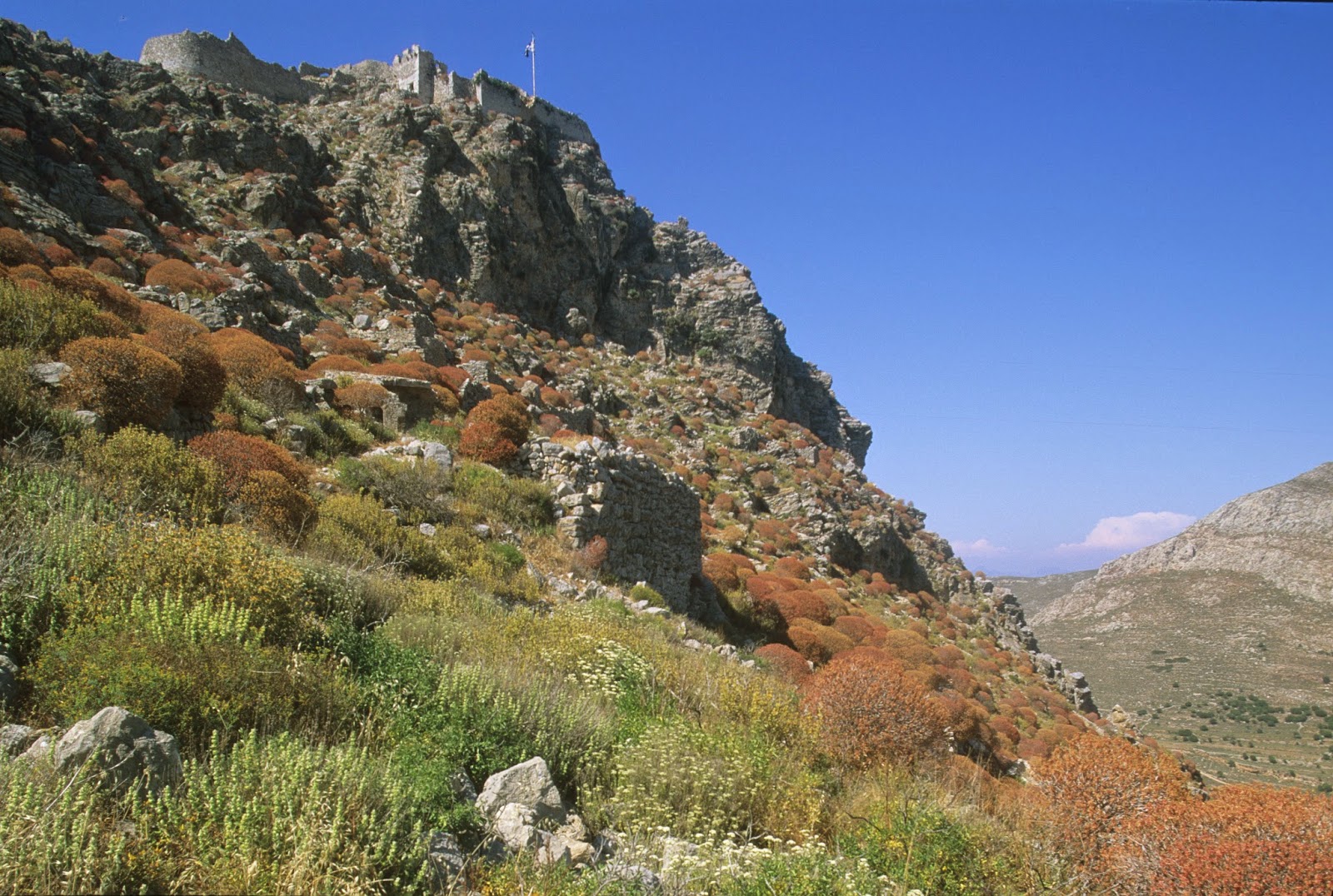
Stavrou Lambrou Tower, Piskopi (Tilos)

The Order of St John granted the islands of Piskopi (Tilos) and Kalkia to Borello Assanti of Ischia at two hundred florins a year. It does not appear that he became a vassal of the Order but the terms of the contract made clear that he had to provide the guard service. The Order reserved the superior lordship of the island while the falcons of the island were reserved for the master as were the rights over shipwrecks. Assanti was also constrained from exacting any service from the islanders that had not been exacted by the Order in the past.

The tower at Stavrou Lambrou is built on an eerie high above the tallest sea cliffs on Piskopi. It is the strongest naturally fortified site on the island.

Stavrou Lambrou Tower

Despite being protected by the castle and towers, its small size and isolated position meant that Piskopi was vulnerable whenever the power of the Turks was in the ascendancy. In 1457 the Turks raided Piskopi together with the islands of Nisyro, Lerro and Kalymno and the village of Archangelo on Rhodes. In 1505 Kamel Reis the Ottoman admiral sacked Piskopi, Lango, Symie and Lerro. Piskopi remained part of the Hospitaller state until the siege of 1522 finally ended  their rule over the Dodecanese.

Sunday, 25 January 2015

Agrosikia Tower, Piskopi (Tilos)

Agrosikia Tower on the small island of Piskopi (Tilos) stands in the hills above the bay of Livadhia in the southeast of the island on the edge of a steep precipice.  The small tower consists of an encircling wall without a gate, entry must have been by ladder which would have been pulled up once the guard was safely inside.


In 1344 an allied fleet of Hospitaller, Papal, Cypriot, French and Venetian galleys used the indented coastline of Piskopi to ambush Yakshi, emir of Marmora in the strait between Piskopi and the Negropont mainland. In an engagement that lasted nine days, the allies outsailed and outfought the Turks who lost over 100 vessels.


Saturday, 24 January 2015

Megalo Choria Castle, Piskopi (Tilos)

Piskopi 'lookout' took its name from its mountains on which the Knights of St John built seven castles and watchtowers, most of them with commanding views over the surrounding seas. Piscopi or Tilos  is 14.5 kilometers long from northeast to southwest and about 8 kilometers at its widest point. It is about halfway between Rhodes and Lango (Cos) and 15 kilometers southeast of Nisyro (Nisyros).


The most important fortified stronghold was the castle on the summit above the present day village of Megalo Chorio. In the Knight's period the villagers lived within the castle walls as protection from pirates. The hillside had been the site of an ancient settlement and parts of the fabric of the castle, in particular the lower courses, the gatehouse and the corner towers were largely constructed from reused Classical masonry.


From the castle are clear views across the sea to Nisyro. The garrison kept watch over the channel and lit a beacon as a signal to Rhodes and the other islands if any shipping was seen passing through the strait.


The need for strong defensive positions to protect the population was emphasized c 1317 when Orcan, son and successor to Osman considered Rhodes to be defenseless in the absence of the rival masters and the division of the Order and descended on Rhodes, in the process capturing Piskopi. He used the island as a depot  for the settlers he brought in his train and sailed on to Rhodes. However Orcan's fleet was defeated by the Vicar-General Gerard de Pins and the Turkish colonists on Piskopi were either put to the sword by the victorious knights of sent into slavery.

Saturday, 17 January 2015

Street of the Knights, Rhodes

When the Convent (headquarters) of the Order of St John was transferred from Cyprus to Rhodes in 1310, the knights reserved the collachium for their own use. Those Greeks who had been living there were moved out as part of the terms of their surrender. The collachium was a separate enclave within the city, divided from the larger town by a high wall running from near the Sea Gate to near the d'Amboise Gate. The wall was protected by strong towers and from 1475, by a moat in front of the wall. The collachium was well guarded;  during Carnival nobody wearing a mask was allowed in. The Knights were only permitted to go into the town when riding a horse, or in pairs if on foot.

To begin with the Convent made use of existing buildings. But as the fledgling state became established it embarked on its own ambitious building programme. Most of the surviving medieval buildings in Rhodes date from the late 15th century, an austere style that manages to combine the ethos of a religious Order of the Church and at the same time reflect the prestige that attached itself to the capital of the Hospitaller State.

Brown sandstone facades  are embellished  by white marble plaques in which coats-of-arms are carved in relief. Some buildings  have decorative carving around the windows and doorways.  One of the most characteristic elements of the Knights' buildings on Rhodes are the  strongly marked string courses. A few of the doorways are  Renaissance in style but the majority are Gothic. However in the architecture of the Convent's buildings it is the east that predominates over the north; most of the buildings are low, without gables and have flat roofs.

The first major building project on Rhodes was the construction of the Conventual Church of St John, in a prominent position in the town, opposite the Palace of the Grand Masters. Like most of the Knights' churches, in the Gothic style but  incorporating Classical masonry in its fabric.The granite columns that divided the nave from the aisles in St John's were taken from the site of an ancient temple while the tombs of Grand Masters' de Juillac(1376) and de Milly (1441) were reused ancient Greek sarcophagi. St John's was accidentally blown up in 1856 and all that remains, apart from the foundations, is the reconstructed Loggia that connected the Conventual Church with the Palace. The Loggia or Circus sive Lobia Conventus was where every knight had to perform gun drill at least once a week. It  crosses the top end of the main thoroughfare running through the Collachium known today as the Street of the Knights.


The Street of the Knights is the grandest street in Rhodes. Along it were most of the auberges or national inns belonging to the different langues. The period that the Order stayed on Rhodes was formative in developing the structure that was to last for most of its subsequent history. What had begun as a largely informal practice on Cyprus became the formal division of the brothers serving at headquarters, the Convent, into their national groups. To begin with there were seven langues at the Convent, ranked according to seniority, Provence, Auvergne, France, Italy, Aragon, England and Germany.

In November 1320 the General Chapter changed the constitution when it decided to assign the great officers of the Order to a particular langue.Thus the pilerii or leaders of each langue held a particular position; the grand commander was the head of the Langue of Provence; the marshal marescalluas was head of the langue of Auvergne; the hospitaller hospitalarius was leader of the Langue of France; the admiral admiratus was hea of the Langue of Italy; the darper magnus conservator was head of the Langue of Aragon; the grand turcopolier, magnus turcopolerius was head of the Langue of England and the treasurer was the hea of the langue of Germany.

The balance of power within the Order caused internal friction during the rule of Grand Master de Lastic (147-1454). The predominant power of the French contingent gave them the majority of the important posts in the administration and this naturally caused resentment within the other national groups. At the General Chapter of 1461 convoked by Grand Master Zacosta a Spanish Knight, it was decided to split the Langue of Aragon into two, one part retaining the old name and rank while the other was named the Langue of Castille and assumed eighth place in the order of precedence.


Each of the langues had its own inn or auberge at Rhodes, most of them along the Street of the Knights. The size and development of each langue's inn or auberge depended on the size of each nation's representation at the Convent. The largest inn belonged to the Langue of Aragon which had the largest number of knights, while the inns of Provence, Auvergne and France were also sizable.

While the knights lived in their own houses elsewhere within the collachium, the inns were where they participated in communal life;  dined together, exchanged the gossip of the day and entertained visitors from Europe. The only members of the langue who lived at the auberge were the novices and junior knights who would have slept in a communal dormitory with in the auberge. While the auberges  project a  plain facade onto the street, many of them have an open gallery at the back that overlooks a private garden.

Near the top of the Street of the Knights part of the Auberge of Provence survives including the magnificent entrance and some parts of the ground floor. The Auberge of Provence was badly damaged in the earthquake of 1481 and was subsequently rebuild at the expense of the munificent Prior of Saint-Gilles, Fra' Charles Amen de la Rochechvaut.

Auberge of Provence

Set above the door is a cruciform frame enclosing the arms of the King of France, the Order, Grand Master del Caretto (151-1521) and Fra' F de Flota.


Opposite the Auberge of Provence on the southern side of the Street is the Auberge of Aragon, the largest auberge on Rhodes.A large doorway in the Aragonese stylle  leads into a barrell vaulted passage from where a stone staircase leads to the principal accomodation on the first floor. Besides five of six smaller rooms is a large hall measuring 19x8m at the front alongside the street which was the assembly chamber of the Spanish knights.

Auberge of Aragon

 From the hall is a passage over the street to the building opposite that may also have belonged to the Inn of Aragon. The escutcheon on the facade belongs to Grand Master Fluvian (1421-1437). After the division of the lange in 1461, the Langues of Aragon and Castille continued to use the same building.

Auberge of Aragon

One of the most imposing inns is the Auberge of France in the Street of the Knights. On the facade two mouldings follow the gradient of the street, the string course separates the ground floor from the upper story . The upper moulding skirts the windows which are decorated with a twisted rope design. Rain water was shed from the roof as the street through conical waterspouts in the form of crocodiles. At the top of the inn is a parapet with battlements, interrupted at intervals by 4 semi circular turrets. Inscriptions on the facade and internal arcade record the names of the founders and the different building phases. Like most buildings on Rhodes the Auberge of  France dates from after the Siege of 1480 and the earthquake the following year.

Auberge of  France

The Inn of Italy at the bottom of the Street is a small building in relation to the number of Italian knights serving at the Convent. A small entrance leads to courtyard with a well; every inn had its own donkey drawn well. On the bottom corner of the Street of the Knights is the magnificent Sacra Infermeria completed in 1483.